Extinct Animals in India
Following are the list of few extinct animals in India.
1.Palaeoloxodon namadicus
Palaeoloxodon namadicus or the Asian straight-tusked elephant, was a species of prehistoric elephant known from the Middle and Late Pleistocene of the Indian subcontinent, and possibly also elsewhere in Asia.


Some authorities regard it to be a subspecies of Palaeoloxodon antiquus, the European straight-tusked elephant, due to extreme similarities of the tusks. Their skull structure was also different from that of a modern elephant. The grouping of this genus is supported by cranial synapomorphies with other species of Palaeoloxodon.[1] Later research suggested that P. namadicus can be distinguished from P. antiquus by its less robust limb bones and more stout cranium.[2]
Palaeoloxodon namadicus is thought to have become extinct during the Late Pleistocene, making it one of four known megafaunal species native to India known to have become extinct during the Late Pleistocene.[3][4] A late record of approximately 56,000 years Before Present is known from the banks of the Dhasan river on the Ganga plain in Uttar Pradesh.[5] In 2015, a study based on extensive research of fragmentary leg bone fossils suggested that P. namadicus may have been the largest land mammal ever.[6]
Remains attributed to P. namadicus or a similar form have been reported from the island of Sulawesi in Indonesia, similar in size to that reported for the Indian subcontinent.[7]
2.Stegodon
Stegodon, meaning "roofed tooth" (from the Ancient Greek words στέγω, stégō, 'to cover', + ὀδούς, odoús, 'tooth') because of the distinctive ridges on the animal's molars, is a genus of the extinct subfamily Stegodontinae of the order Proboscidea. It was assigned to the family Elephantidae (Abel, 1919), but has also been placed in the Stegodontidae (R. L. Carroll, 1988).[1] Stegodonts were present from 11.6 million years ago (Mya) to the late Pleistocene, with unconfirmed records of localized survival until 4,100 years ago. Fossils are found in Asian and African strata dating from the late Miocene; during the Pleistocene, they lived across large parts of Asia and East and Central Africa, and in Wallacea as far east as Timor.[1][2][3]


A review of 130 papers written about 180 different sites with proboscidean remains in southern China revealed Stegodon to have been more common than Asian elephants; the papers gave many recent radiocarbon dates, the youngest being 2,150 BCE (4,100 BP).[2] However, Turvey et al. (2013) reported that one of the faunal assemblages including supposed fossils of Holocene Stegodon (from Gulin, Sichuan Province) is actually late Pleistocene in age; other supposed fossils of Holocene stegodonts were lost and their age cannot be verified. The authors concluded that the latest confirmed occurrences of Stegodon from China are from the late Pleistocene, and that its Holocene survival cannot be substantiated.[4]

3.Sivatherium
Sivatherium ("Shiva's beast", from Shiva and therium, Latinized form of Ancient Greek θηρίον - thēríon) is an extinct genus of giraffids that ranged throughout Africa to the Indian subcontinent. The species Sivatherium giganteum is, by weight, one of the largest giraffid known, and also one of the largest ruminants of all time.[3] The Afro-Asiatic species, S. maurusium, was once placed within the genus "Libytherium".

Sivatherium originated during the Late Miocene (around 7 million years ago) in Africa and survived through to the late Early Pleistocene (Calabrian)[4] S. giganteum remains have been recovered from the Himalayan foothills, dating around 1 million years ago. Suggestions have been made that S. maurusium may have gone extinct as recently as 8,000 years ago, as depictions that resemble it are known from ancient rock paintings in the Sahara[5] and Central West India.[6] But these claims are not substantiated by fossil evidence, and the depictions likely represent other.
4 . Megalochely
Megalochelys ("great turtle") is an extinct genus of cryptodiran tortoises that lived from the Miocene to Pleistocene. They are noted for their giant size, which is among the largest of any known testudine, with a maximum carapace length over 2 m (6.5 ft) in M. atlas. During the dry glacial periods it ranged from western India and Pakistan (possibly even as far west as southern and eastern Europe) to as far east as Sulawesi and Timor in Indonesia, though the island specimens likely represent distinct species.[4]

One species of Megalochelys, M. atlas, is the largest known tortoise, with a shell length over 2 m (6.6 ft), an estimated total length of 2.7 m (8.9 ft), and an approximate total height of 1.8 m (5.9 ft).[5] Popular weight estimates for this taxon have varied greatly with the highest estimates reaching up to 4,000 kg (8,800 lb) in some instances.[6] However, weights based on volumetric displacement of the skeleton,[7] or inferences based on two-dimensional skeletal drawings,[8] indicate that M. atlas was probably closer to 1,000 to 2,000 kg (2,200 to 4,400 lb) in mass. M. atlas is thus the largest known tortoise. The only larger turtles were the marine Archelon and Protostega from the Cretaceous Period, and the aquatic, freshwater Stupendemys of the South American Late Miocene. A similarly gigantic tortoise, Titanochelon, is known from the Miocene to Pleistocene of Europe, which had shell lengths of up to 2 m (6.6 ft).
Like the modern Galápagos tortoise, M. atlas' weight was supported by four elephantine feet. Like other tortoises, it is thought to have been herbivorous.
5. Aurochs
The Indian aurochs[a] (Bos primigenius namadicus) (Sindhi: انڊين جهنگلي ڏاند) is an extinct aurochs subspecies that is considered the wild ancestor of the domestic zebu cattle, which is mainly found in the Indian subcontinent and has been introduced in many other parts of the world, like Africa and South America. In contrast, the domesticated taurine cattle breeds, which are native to Europe, the Near East, and other parts of the world, are descendants of the Eurasian aurochs (Bos primigenius primigenius). According to IUCN, the Indian aurochs disappeared before the 13th century AD, leaving only the Bos primigenius primigenius, whose range was by then restricted to Europe.[1] The wild population of Indian aurochs was likely extinct millennia earlier than that; the most recent skeletal remains, from Uttar Pradesh, date from around 1,800 BC.[3]

6 . Sumatran Rhinoceros
The Northern Sumatran rhinoceros (Dicerorhinus sumatrensis lasiotis), also known as Chittagong rhinoceros or northern hairy rhinoceros was the most widespread subspecies of Sumatran rhinoceros, as well as the only known subspecies native to mainland Asia.


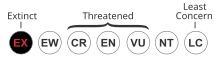
While it has been officially declared as extinct on multiple occasions in early 20th century, it has been reported that small populations might still exist in the wild, such as in Burma and the Malaysian Peninsula, though it is highly doubtful.[2][3] As of 2008, it is considered as "Critically Endangered" by IUCN.
Source
https://en.m.wikipedia.org/wiki/List_of_extinct_animals_of_India
Date
09 April 2022
Nice information
ReplyDeleteNice broo
ReplyDeleteNice info 👌👌
ReplyDeleteNico information👍👍
ReplyDeleteNice information bro
ReplyDeleteNice one🔥
ReplyDeleteNice Information👌
ReplyDeleteBeautifully written
ReplyDeleteBest🔥🔥
ReplyDeleteThnx for sharing such a important information#greatJob
ReplyDeleteNice information
ReplyDelete